
A polo shirt is highly deceptive in its simplicity. Two or three buttons, a collar, short sleeves, and a straight hem. The pattern hasn’t fundamentally evolved since René Lacoste first introduced it to the tennis courts in 1926—a full century ago. Yet, the chasm between a polo that warps in three months and one that remains immaculate for ten years is massive. That difference lies in the micro-details most brands refuse to talk about.
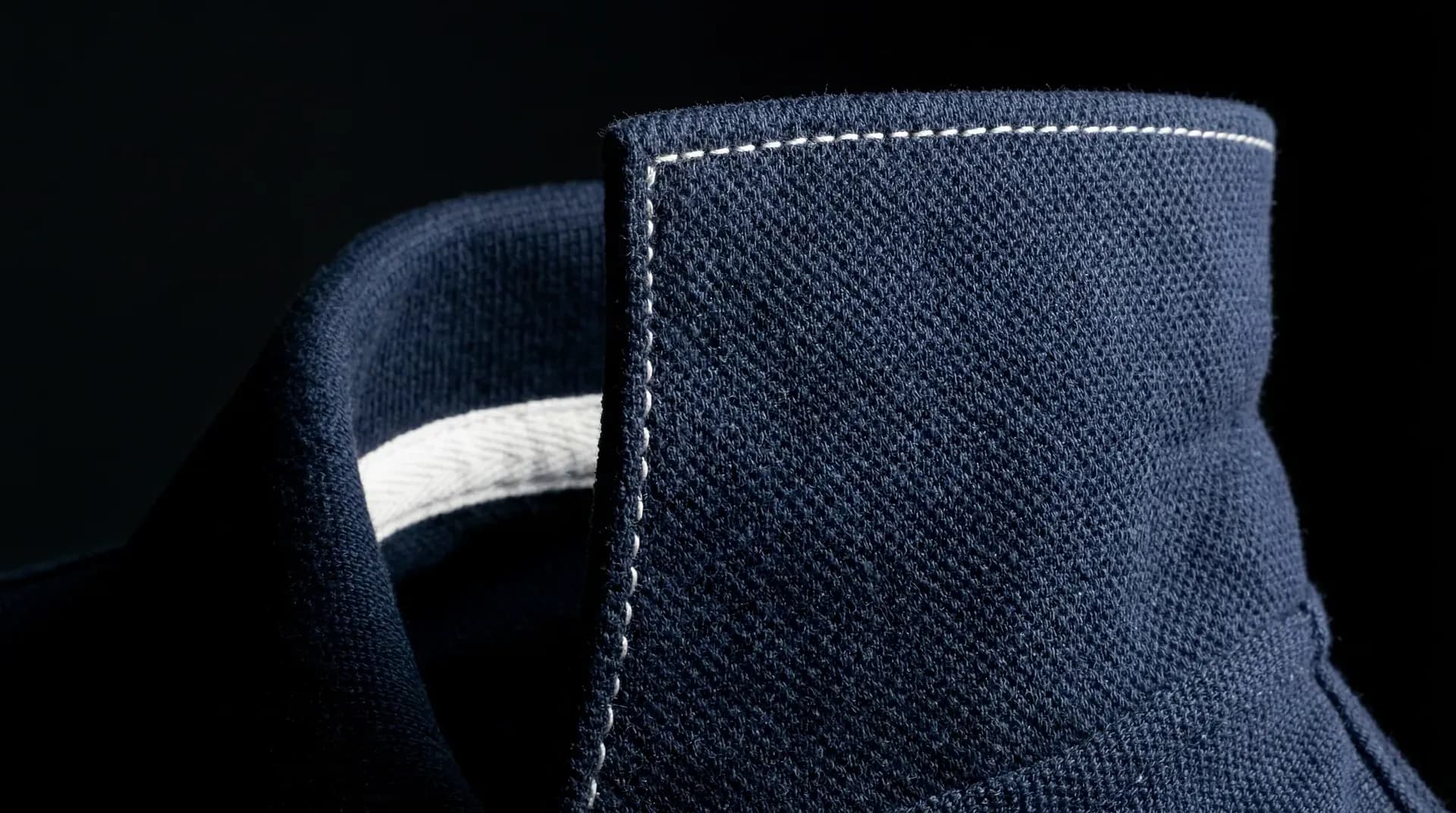
Let’s start with the collar. On a standard, mass-produced polo, the collar is simply a single layer of basic piqué or low-grade knit, occasionally stiffened with a cheap fusible lining. After five washes, the tips curl. After twenty, it collapses completely. The architecture the collar was meant to maintain—a sharp, upright frame around the neck—is completely gone. This isn’t normal wear and tear; it is an engineering failure.
A collar built to endure is engineered from premium, high-density yarn, specifically knitted to lock its geometry permanently into place. It acts as a structural foundation, preserving the collar’s precise architecture through hundreds of wash cycles without warping. This level of detail requires significant investment in premium materials, specialized machinery, and production time, yet it is the single most definitive indicator of whether a garment was built to perform or merely built to sell.
Let us examine the seams. On a budget polo, a single basic overlock machine handles every join—side seams, shoulder seams, sleeve attachments—all utilizing the identical stitch type, tension, and thread. The result is predictably flawed: seams that pucker after repeated washing, uneven tension that distorts the garment's balance, and a polo that begins to spiral around the torso within mere months. Our production line operates on a fundamentally different philosophy. Each specific seam type is executed by a dedicated, specialized machine: advanced overlock for side joins, flatseams for shoulder construction, coverstitch for hems and sleeve finishes, and precision machinery for collar attachment. Furthermore, the thread running through every single needle is sourced from the global leader in industrial sewing threads—engineered for consistent tension, superior colorfastness, and enduring seam integrity. While thread quality remains invisible to the buyer at the point of sale, it is the ultimate determinant of whether a seam retains its structural integrity after a hundred washes or unravels after ten. The precise machine for every seam; the perfect thread in every machine.
Fabric weight governs everything the seams and collar interact with. Below 180 GSM, a polo piqué simply lacks the physical mass to support its own structure. The fabric stretches under its own weight on a hanger, and gravity elongates the body slightly with every wear. At 260 GSM, the knit begins to function as a self-supporting architecture. At 340 GSM—the baseline for our True Base 96 polo—the fabric possesses enough density to hold its geometry flawlessly without requiring internal reinforcement in the body panels. The collar stands firm simply because the fabric it anchors to stands firm.
Then there is the placket—the functional strip of fabric housing the buttons. On a meticulously constructed polo, the placket is an entirely separate piece, cut with absolute precision and attached with structural integrity. On an inferior garment, it is merely an extension of the front panel, hastily folded and pressed. The difference reveals itself post-wash: the separate placket lays perfectly flat, while the folded version buckles and warps uncontrollably.
Buttons carry far more weight than you might assume. Polyester buttons are the industry standard because they are incredibly cheap and withstand the heat of industrial presses. But they eventually crack, lose their luster, and dramatically cheapen the garment’s overall aesthetic. High-density resin or natural corozo nut buttons retain their premium surface finish and resist cracking through a lifetime of use. It is a deliberate investment in quality that maintains the garment’s premium visual impact for decades.
Finally, we arrive at quality control. In mass production, inspection is purely statistical. A random sample from a massive batch is checked; if it passes, the entire batch ships. In precision manufacturing, every single garment earns its approval. At True Base 96, each polo must clear a minimum of 12 stringent, individual hand-checkpoints bridging the journey from raw fabric to finished product. Seam integrity, collar geometry, stitch density, button security, fabric consistency, and color accuracy are all rigorously verified by experienced human hands—not by an algorithm.
A polo is simple. Engineering one that lasts is anything but.