
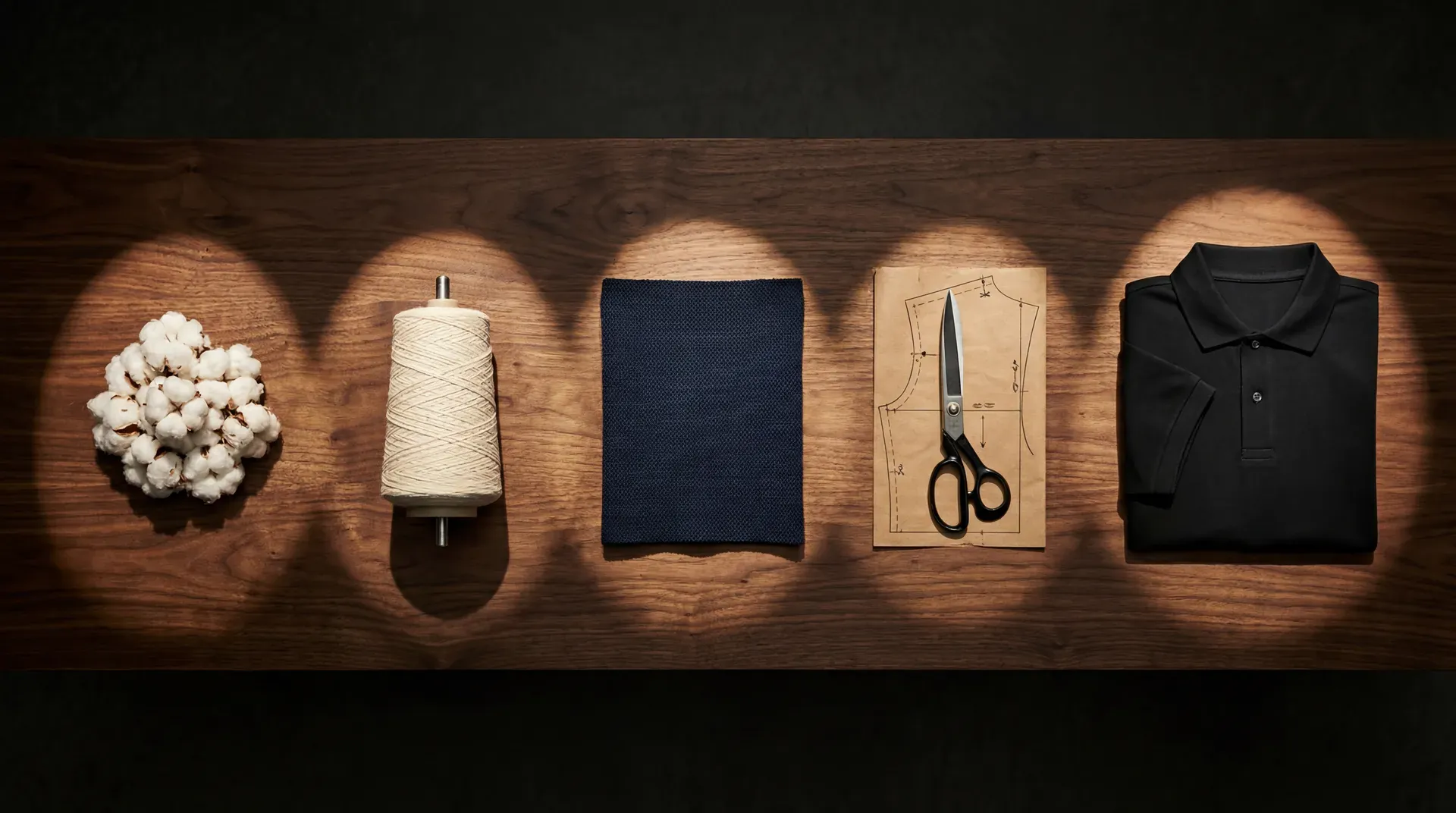
The phrase "vertically integrated" is plastered across countless brand websites today. It has been adopted as a universal trust signal—a convenient shorthand for quality and transparency. But like most terms hijacked by marketing departments, its true meaning has been severely diluted. A brand that buys greige fabric from one mill, ships it to another facility for dyeing, contracts a third party for cutting, and relies on a fourth factory for assembly is not vertically integrated. That is merely a fragmented sourcing operation hiding behind a slick supply chain presentation.
True vertical integration means exercising absolute control over the entire process—from raw material to the finished garment—within a single, unified production ecosystem. It means the very same organization that selects the cotton also spins the yarn, knits the fabric, applies the finishing processes, cuts the patterns, sews the garments, and conducts the final quality inspections. Each stage continuously informs the next. Any problem encountered is solved internally and immediately, rather than being passed down the line to blame the next vendor.
Why is this so crucial? Because quality is not something you can simply inspect into a product at the end of an assembly line. Quality must be engineered at every single step, and every handoff between independent suppliers is a massive point of potential failure. When a fabric mill operates entirely separate from the garment manufacturer, the feedback loop between "this yarn behaves inconsistently under our needles" and "we need to adjust the spinning tension" can take weeks to resolve. In a truly integrated system, it takes hours.
True Base 96 operates out of Türkiye, leveraging an advanced infrastructure painstakingly built over three decades. Our production pipeline encompasses raw yarn selection, proprietary fabric development, precision knitting, chemical and ozone finishing, cutting, sewing, exhaustive quality control, and final packaging—all executed within a seamlessly connected ecosystem. When we develop a new textile, we test its behavior during knitting, adjust the parameters during finishing, and verify its performance during garment assembly. This all happens within the same facility ecosystem, within the exact same week.
This deep integration is precisely what makes proprietary fabric development possible in the first place. Our defining fabric families—from the dense 340 GSM mercerized Pima interlock to the rugged 520 GSM three-yarn diagonal, down to our exclusive cashmere-Pima atelier blends—are not simply picked from a supplier’s catalog. They are engineered entirely in-house. We fine-tune the yarn specifications, knit gauges, and chemical finishing parameters across multiple production runs until the fabric flawlessly meets our uncompromising standards. You cannot achieve this when you are restricted to buying a mill’s existing inventory.
The advantage of absolute traceability is equally undeniable. When a customer purchases a True Base 96 garment, the fiber origin, exact yarn specification, knit construction parameters, finishing methods, and complete inspection history are fully documented within our own system. This isn’t some trendy blockchain experiment or a QR-code marketing gimmick. It is the natural, inevitable consequence of owning your production chain. When every single stage happens under your roof, provenance isn’t something you have to actively reconstruct—it’s something you fundamentally know.
Operating this model comes at a steep cost. Vertical integration demands massive capital investment in cutting-edge machinery, expansive facilities, and highly specialized technical expertise across drastically different disciplines. It requires decades of compounded knowledge—not just about how to sew a straight line, but mastering yarn behavior, knit engineering, advanced chemical finishing, and rigorous quality assurance systems. It is undeniably slower to scale than the ubiquitous "brand-and-outsource" model. It is heavier, and it is harder to pivot when superficial fashion trends shift.
But it guarantees the one thing that outsourced production never can: absolute consistency. The identical garment, with the exact same premium quality, across every single production run. This doesn’t happen by luck or through aggressive vendor negotiations. It happens because the system itself is mathematically designed to eliminate variation. Thirty years of relentless refinement has forged an infrastructure where the question is no longer "Can we produce this level of quality?" but rather, "Is it even possible for the quality to be anything else?"
This is what vertical integration actually looks like. It isn’t a neat supply chain diagram drawn on a website. It is a deeply rooted production culture—decades in the making—where every single decision, from fiber to finish, is executed under one roof.