
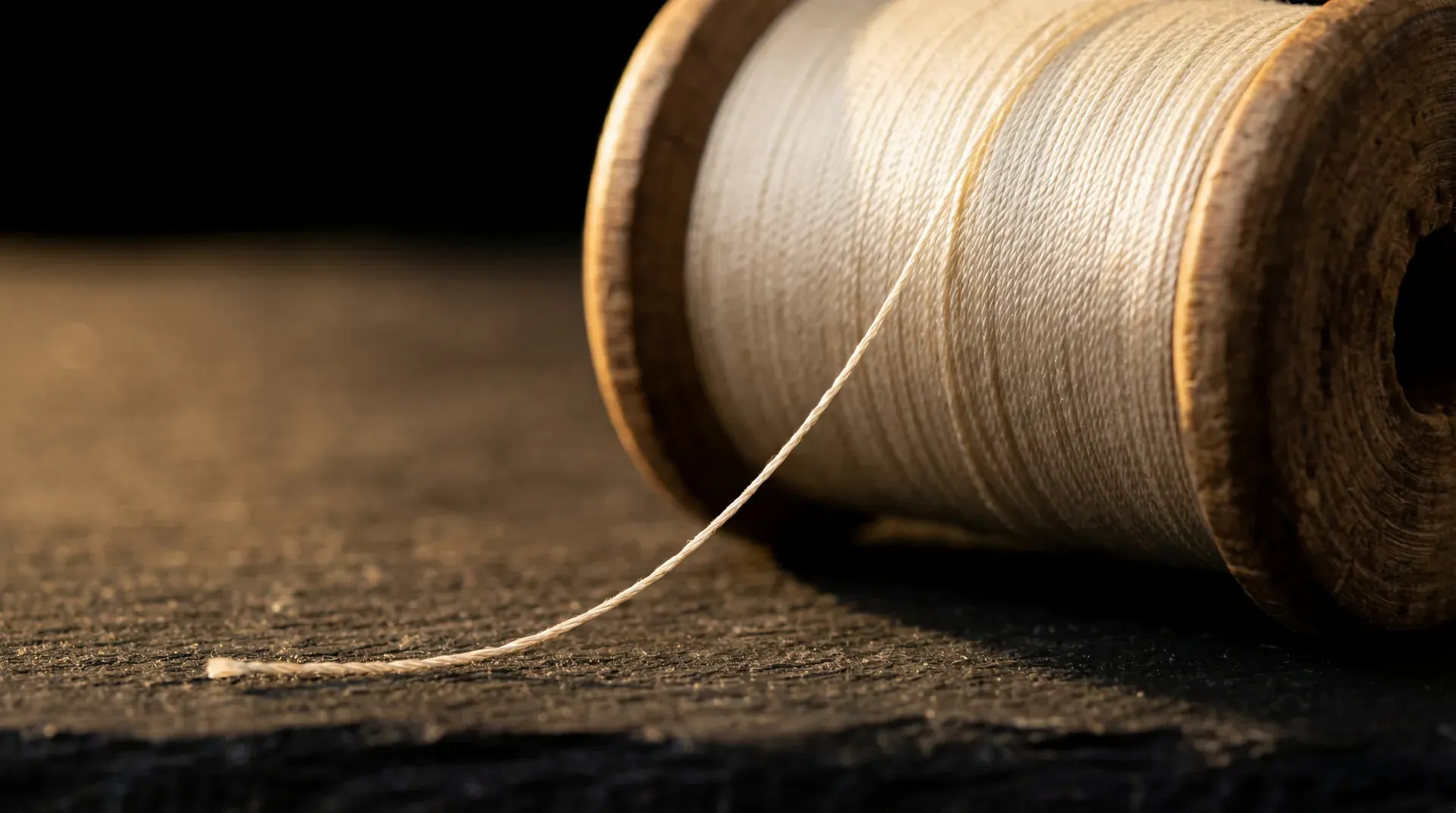
Every garment begins with a single thread. And within that thread lies a decision that determines everything that follows: how the fabric drapes, how it ages, whether it pills after three washes or holds its form for three decades. That decision is yarn count.
Yarn count is measured by a simple number: Ne, the English cotton count system. The higher the number, the finer the fiber. Ne 20 is industrial workwear territory. Ne 30 is your average department store polo. Ne 50 is where textile engineering truly begins. At this count, the fiber is fine enough to create a dense, luxurious surface, yet strong enough to maintain structural integrity under tension, wash after wash.
But fineness alone is not enough. A single Ne 50 yarn is delicate. It feels beautiful to the touch, but it is structurally vulnerable. It will pill. It will thin out. It will lose its geometry within months. This is exactly why ply matters, and why the second number in "50/2" changes the entire equation.
Two-ply construction means two individually spun Ne 50 yarns are twisted together under strictly controlled tension. The result is a unified thread that combines the ultra-smooth surface feel of fine cotton with the structural resilience of a much heavier material. It aggressively resists abrasion. It holds dye more evenly. It creates a fabric surface with a depth and consistency that a single-ply yarn simply cannot achieve, no matter how much chemical finishing is applied.
This is what we call the engineering sweet spot. Go finer than Ne 50, and the fabric becomes too fragile for daily wear. Go coarser, and you sacrifice the premium hand feel that separates engineered knitwear from basic commodities. The 50/2 specification sits precisely at the intersection of durability and refinement. It is not a compromise; it is a solution.
But yarn count is only half the story. How that yarn is finished dictates the final character of the fabric. Mercerization—a highly controlled chemical bath applied under tension—swells each cotton fiber by approximately 30 percent. The result is quantifiable: increased luster, superior dye uptake, and significantly higher tensile strength. The yarn reflects light instead of absorbing it. It locks in color instead of fading. It resists pilling instead of generating it. This isn’t a cosmetic choice; it’s a structural upgrade at the molecular level.
Not all cotton responds equally to this process. Short-staple cotton—the standard fiber in mass-produced garments—measures just 20 to 28 millimeters. Pima cotton, cultivated in controlled environments in Peru and the American Southwest, yields fibers measuring 35 to 40 millimeters. These extra-long staples interlock far more securely during spinning, creating a smoother, stronger, and completely uniform yarn. When mercerized, the difference is visually striking: a subtle, natural luminosity that standard cotton can never replicate.
At True Base 96, our base fabrics start at a dense 340 GSM, utilizing 50/2 mercerized Pima cotton in a robust interlock construction. This is not an arbitrary choice. It is the culmination of three decades of development, answering one fundamental question since 1996: What is the absolute minimum engineering standard required for a garment to retain its shape, color, and character for a lifetime?
The answer wasn't found in the sewing room. It wasn't in the pattern cutting. It was always in the yarn. Everything begins with 50/2.